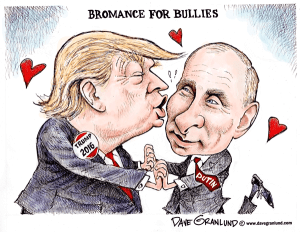
By: Unnamed Source Close to the Popcorn Machine in the Situation Room
Once upon a time—somewhere between the Helsinki hand-holding and the “he’s a strong leader” soundbites—Donald Trump and Vladimir Putin were the geopolitical equivalent of a reality TV power couple. They complimented each other’s hair, exchanged wink-laden compliments at summits, and whispered sweet nothings about NATO in private. But like all tragic celebrity romances, this one, too, has gone nuclear—literally.
The Breakup Heard Around the Globe
According to leaked Mar-a-Lago group chat messages, the rift began when Trump found out that Putin unfollowed him on Truth Social and replaced him in his phone with a contact labeled “Generic Orange Billionaire.” Worse still, when Trump tried to FaceTime him during a Fox News segment, Putin declined the call and sent back a GIF of a Siberian bear eating a cheeseburger labeled “American Dreams.”
Trump, feeling slighted and possibly bloated from too many Diet Cokes, fired back during a campaign rally in Iowa:
“You know, Vladimir was my guy. Strong guy. Very strong. But he’s been very disrespectful. Sad! And quite frankly, folks, I think he’s jealous of my nuclear button. It’s much bigger.”
Warships and War of Words
Fast forward to this week, and the U.S. Navy has now parked a few nuclear-capable ships just outside Russian waters “for vibes,” according to a Pentagon spokesperson wearing aviators indoors.
“The President told us to show ‘dominance, not dependence,’” said Rear Admiral Larry “No Chill” McGuffin. “So here we are. Floatin’ freedom just off the coast of Vladivostok.”
In response, Putin allegedly ordered his own fleet to play Taylor Swift’s “We Are Never Ever Getting Back Together” on loudspeakers in a loop, escalating the pettiness to DEFCON-3.
The Final Straw
Sources say the final straw came when Putin ghosted Trump at the G20 buffet line, refusing to pass the cocktail shrimp. Trump retaliated by calling Putin’s latest campaign photo shoot “low energy” and suggesting the Russian president had “aged poorly—like a Soviet potato.”
The Future: Uncertain, But Highly Entertaining
Now, with tensions high, egos bruised, and memes flying faster than hypersonic missiles, the world watches nervously as the once-flirtatious duo trades insults and international threats like jilted lovers in a parking lot outside a Florida Waffle House.
In the meantime, the UN has appointed a relationship counselor named Janice who previously handled disputes between Taylor Swift and Spotify. She’s reportedly optimistic but realistic:
“At this point, I’d settle for them muting each other.”
As for Trump? He’s already teasing a new book titled “From Kremlin With Love: My Breakup With Vlad” and has promised that if reelected, he’ll only do diplomacy with “stronger, hotter dictators.”
And Putin? He’s busy teaching his horse to moonwalk and reportedly swiping right on Kim Jong Un.
Diplomacy is dead. Long live the drama.
So how did we get here?
Act I: Love in a Time of Sanctions
In 2016, the Trump-Putin dynamic began with something just shy of geopolitical flirtation. Trump praised Putin’s strength and leadership, while Putin responded with calculated approval. From their infamous 2018 Helsinki summit, where Trump publicly questioned his own intelligence agencies in favor of Putin’s denials, to Trump’s repeated attempts to soften the U.S. stance on Russia, the two leaders appeared more aligned than the NATO treaty.
But even codependent relationships fracture.
Act II: The Fall—Frozen Assets and Fractured Egos
Behind closed doors, their relationship began to fray post-presidency. According to aides close to both camps, Putin never took Trump seriously once he left office, reportedly referring to him as “a loud American with small dogs and big flags.” Meanwhile, Trump fumed privately about Putin’s invasion of Ukraine—an event Trump publicly waffled on but privately saw as a “snub.”
The true unraveling began when Putin refused to endorse Trump’s 2024 campaign, instead praising “more stable” American leadership—believed to be a backhanded compliment aimed at Biden. Trump, livid, reportedly shouted in a Mar-a-Lago meeting:
“I made Vlad popular. Nobody even cared about him before me!”
It didn’t help that Russia signed a new economic pact with China and refused to renew Trump’s secret “backchannel golf diplomacy deal” (yes, that was a thing). At this point, Trump began referring to Putin in campaign speeches as “Vlad the Very Bad,” a phrase now printed on limited-edition MAGA hats.
Act III: Provocation and Escalation
Russia, sensing weakness or desperation, moved warships into Arctic waters near Alaska and increased surveillance over NATO airspace. Trump, running on a campaign of “dominance, not diplomacy,” saw this as the perfect moment to appear strong.
Within 72 hours of a particularly heated rally in Ohio—during which he accused Putin of “stealing the spotlight and possibly Melania’s playlist”—Trump ordered the U.S. Navy to dispatch a carrier group and two nuclear-armed submarines to the Barents Sea.
The White House released a statement simply titled: “You Mess With the Trump, You Get the Boom.”
Pentagon officials reportedly tried to walk the order back, but Trump had already live-streamed himself signing it on Truth Social while eating a Big Mac and quoting Red Dawn.
Act IV: Global Anxiety and a Side of Chaos
European allies are caught between a nuclear standoff and a former president who refuses to attend security briefings that don’t come with chicken tenders. Russia has responded with military drills, veiled threats, and a state TV segment titled “The American Emperor Has No Clothes.”
Diplomats are scrambling. NATO leaders are urging calm. And ordinary people around the globe are wondering how two egomaniacs managed to turn a broken friendship into a near-global crisis.
What Now?
The world waits. Will this all end in negotiations, a new cold war, or just another round of campaign merchandise? No one knows. But one thing is clear: this whole mess started with unchecked egos, personal grudges, and a dangerous cocktail of power, pride, and zero accountability.
And in the end, it might not be ideology or nationalism that leads us into conflict—but two grown men who couldn’t take being left on read.
Let’s hope cooler heads prevail… and maybe that Janice from the UN brings snacks to the next emergency summit.
You’re absolutely right — attention is a fundamental human craving, and social media has turned it into an all-out spectacle. For many, it’s validation, connection, or a sense of importance. For some, it becomes the oxygen they breathe.
When it comes to Donald Trump, attention isn’t just something he seeks — it’s central to his entire persona and strategy. What I can deduce about what he’s seeking goes beyond simple fame:
1.
Validation and Power
Trump’s public persona thrives on being seen as dominant and successful. Attention, especially on his own terms, reinforces his self-image as a winner and a figure of authority. It validates his sense of power and influence.
2.
Control of the Narrative
By commanding attention, Trump controls what millions focus on—whether it’s him, his policies, or controversies. This puts him in a position to shape public discourse, distract critics, and energize supporters.
3.
Legacy and Influence
Trump likely seeks to cement his place in history—not just as a businessman or former president, but as a cultural and political force. The constant attention keeps his brand alive and ensures his voice remains central in American politics.
4.
Connection and Belonging
On a human level, the relentless attention might feed deeper needs: to be recognized, heard, and accepted by a broad audience, especially those who share his worldview.
So, in essence, Trump’s attention-seeking is multifaceted—it’s about power, control, legacy, and a complex form of belonging.
What’s your take? Do you think attention is enough for someone like him, or is it just the surface of something deeper?
 PRAGMATIC ISSUES
You must be logged in to post a comment.