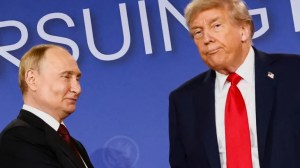
At its core, this isn’t just a policy tweak—it’s a geopolitical realignment that potentially shifts America out of Ukraine’s corner and, whether intentionally or not, closer into Putin’s. It not only makes America look weak and pathetic, is tells the world we have no intention of defending democracy.
When President Trump walked out of his Alaska summit with Vladimir Putin last week and announced he was dropping the U.S. demand for a ceasefire in Ukraine before peace talks, the shock was immediate. For Kyiv, it felt like abandonment. For Europe, it looked like weakness. But here in America, for many citizens across the political spectrum, it felt like something more personal: betrayal.
Breaking America’s Word
For two years, Americans were told by both Republican and Democratic leaders that the United States would stand with Ukraine “for as long as it takes.” That phrase became the shorthand for America’s commitment—not only to Ukraine but to the idea that a democracy under attack should not be left to fight alone.
Now, in a single press conference, that promise has been undercut.
“I don’t care if you voted for him or not—when America makes a promise, we’re supposed to keep it,” said John R., 52, a veteran from Ohio who served in the first Gulf War. “We already spent billions, we already sent weapons. To pull the rug now, it makes us look like we were lying the whole time.”
Many Americans feel like Trump didn’t just betray Ukraine—he betrayed America’s word, America’s values, and America’s security in the process and he made himself look foolish by promising a ceasefire then, caving to Putin’s demands.
Cozying Up to the Aggressor
What made the sting worse for many Americans wasn’t just the reversal itself, but the optics: Trump standing shoulder-to-shoulder with Putin, echoing his talking points about “getting to a peace deal” without mentioning Russia’s ongoing shelling of Ukrainian cities.
Trump went forward and showed the world his undying love. loyalty and commitment to Putin.
“It’s like watching your quarterback huddle with the other team,” said Maria P., 34, a teacher from Colorado. “Putin’s the guy who started this war. He’s the one bombing homes and schools. And somehow Trump’s language sounded closer to his than to Zelenskyy’s.”
Even some longtime Trump supporters were uneasy. “Look, I like Trump. I voted for him,” said Dan M., 61, a retired trucker in Michigan. “But if you’re telling me we’re just gonna let Putin take what he wants, that doesn’t sit right. We beat the Soviets once. Why roll over now?”
For many Americans, this isn’t just about Ukraine. It’s about what the U.S. says it stands for.
“We tell the world we defend freedom and democracy,” said Lisa H., 28, a grad student in Washington, D.C. “And then the President shrugs and says, ‘Russia’s a big power, you gotta make a deal.’ That’s not leadership. That’s giving up.”
For U.S. veterans, especially those who spent years in Iraq or Afghanistan, the reversal carries a bitter taste. “We were told we were fighting to stop tyranny, to protect people,” said Mark S., 45, a Marine Corps veteran from North Carolina. “Now we’re supposed to smile while Trump hands territory to a dictator? It feels like all those speeches were just hot air.”
Beyond values, there’s a cold security calculation that gnaws at Americans too. If Washington won’t stand firm in Ukraine, what about NATO? What about Taiwan?
“My son is in the Navy,” said Angela T., 49, a mom from Florida. “And I’m scared. Because if China takes this as a green light, he could be the one fighting next. I don’t want him to die because America looked weak now.”
Even Americans wary of foreign entanglements sense danger in Trump’s pivot. “I don’t want endless wars,” said Ray L., 38, an independent voter from Arizona. “But peace doesn’t mean giving dictators what they want. That just makes more wars later. My granddad used to say that’s how we got World War II.”
America – A Fractured Image
Perhaps the deepest cut is symbolic. For decades, America—however imperfectly—told the world it was the defender of liberty. Standing by Ukraine became the latest test of that idea.
By aligning so closely with Putin’s framework, Trump hasn’t just changed policy; he’s shaken that identity.
“He didn’t just betray Ukraine,” said Nancy K., 67, a retired nurse from Wisconsin. “He betrayed America’s word, America’s values, and America’s honor. That’s harder to get back than any piece of land in Donbas.”
The Political Betrayal
Abandoning U.S. promises. For years, Americans were told that Washington stood with Ukraine “for as long as it takes.” Trump’s sudden reversal feels like breaking America’s word—not just to Ukraine, but to allies who trusted that pledge.
Making Putin the winner. Many Americans remember Reagan’s Cold War legacy of “peace through strength.” By appearing to concede to Putin’s terms, Trump looks like he’s flipping that legacy on its head—trading strength for appeasement.
Congress left in the dark. Americans who believe in constitutional checks and balances see Trump’s move as bypassing congressional oversight on foreign commitments.
The Moral Betrayal
Abandoning democracy. Americans who supported aid to Ukraine saw it as defending democracy against dictatorship. Trump’s shift looks like cozying up to the dictator instead.
Disregarding sacrifice. Americans feel their tax dollars, billions already spent, and weapons already shipped are now being undermined. If the U.S. gives up on Ukraine, what was the point of that sacrifice?
Signal to veterans. For U.S. veterans who fought against authoritarian regimes, this feels like a slap in the face—especially those who see Putin as America’s adversary, not a partner.
The Security Betrayal
NATO credibility weakened. Americans who believe in alliances feel this decision undercuts NATO’s entire deterrence structure—making future wars more likely, not less.
Taiwan & beyond. Many Americans immediately connect this to China: If we fold on Ukraine, will we fold on Taiwan too? That fear of a domino effect feels like betrayal of global security commitments.
America first—or America alone? Even some Trump voters worry that stepping back in Ukraine could isolate America and leave allies less willing to help when the U.S. faces threats.
The Symbolic Betrayal
Trump standing with Putin, not Ukraine. The image of Trump in Alaska, smiling alongside Putin, while Ukrainians are still dying daily, hit hard for many Americans. It looked less like diplomacy and more like siding with the aggressor.
“Make a deal” vs. “stand for principles.” Americans are used to leaders at least pretending to uphold principles abroad. Trump’s transactional language—telling Zelensky “Russia is a big power, you gotta make a deal”—felt cold, dismissive, and un-American to many.
Erosion of moral leadership. For decades, the U.S. cast itself as the defender of liberty. To Americans who believe in that story, Trump’s move feels like shredding it in favor of raw power politics.
History will judge whether Trump’s gamble leads to a peace deal or to further bloodshed. But in living rooms and diners across the U.S., the verdict is already in: this doesn’t feel like tough deal-making. It feels like America turned its back.
And to many Americans, that’s the kind of betrayal that stings far deeper than politics.
 PRAGMATIC ISSUES
You must be logged in to post a comment.