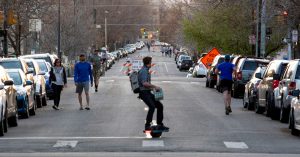
Denver’s politicians have a dream. A gleaming, eco-friendly dream where sleek buses glide down Colfax, cyclists own the road, and the average Denverite trades in their Subaru for a bus pass. It’s a vision of a city where cars are relics and public transit reigns supreme.
But let’s cut through the ribbon-cutting speeches and sustainability hashtags, this dream is nowhere near reality.
Our leaders stand at podiums, waving their hands about a future where buses, bikes, and trains magically replace cars. They imagine a city where we all live downtown, hop on a bus at sunrise, and stroll past bustling storefronts on the 16th Street Mall.
But walk the Mall today and tell me this vision is not a joke. It is a hollow shell, a graveyard of what used to be the beating heart of the city. Empty storefronts, boarded-up shops, and more pigeons than people. This is the model for a “car-free utopia”?
Politicians Are Playing SimCity With Real Lives
Denver leaders love to pitch these utopian schemes because they sound visionary. “Imagine hopping on a bus that zips you downtown in minutes!” they gush. But that “minutes” bus trip is often a 45-minute ordeal—if the bus shows up at all. Imagine taking two connections just to get to your job in Englewood or Aurora, while lugging groceries or trying to drop your kids off at school.
Do our politicians actually ride RTD, or do they just ride the applause of urbanist conferences?
They’re asking working-class people to give up their cars without giving them anything reliable in return.
That isn’t vision.
That’s delusion.
The Fantasy vs. the Freeway
Politicians keep pushing projects that signal a “post-car” Denver, massive investments in Bus Rapid Transit lanes, squeezing parking, cutting required parking minimums, touting climate goals. They speak as if Denver is Paris or New York, where density makes transit king. But here’s the cold and hard truth, Denver is not a walking city.
It sprawls.
It stretches.
Mayor Mike Johnston and city council members, Governor Polis keep selling the dream: “Denver will lead on climate!” “Public transit will connect us all!” They smile for cameras and nod to planners at conferences and, they have never tried to take the No. 15 down Colfax at 9 p.m. themselves.
The reality?
RTD is unreliable, underfunded, and unsafe.
Service has been slashed, trains are empty, buses are late, and riders feel abandoned.
Politicians talk about weaning us off cars as if the infrastructure to do so exists.
It doesn’t.
Meanwhile, Denverites, workers, parents, and small business owners, are stuck with the bill.
Parking disappears.
Traffic lanes vanish.
Costs of living climb.
And the politicians shrug, telling you to “just take the bus.”
Our neighborhoods are not stitched together like Manhattan blocks, they are spread across miles of asphalt, cul-de-sacs, and highways.
You cannot will a car-free city into existence when the blueprint of the city is already car-dependent.
Denver grew up in the age of the automobile.
The bones are set.
The Cost of Pretending
Push cars out of the picture without fixing transit, and what do you get?
You do not get climate progress.
You do not get equity.
You get resentment.
You get small businesses suffering because their customers cannot park.
You get families punished for living outside the tiny bubbles where transit actually works.
And let us not forget: RTD has been bleeding riders for years. Fares climb, service shrinks, and crime on trains makes evening commutes feel like a gamble. Denver does not need to fantasize about killing the car—it needs to fix the transit it already has.
Besides, killing parking before fixing transit is not visionary, it is punitive. It punishes working people while pretending to save the planet.
Even if Denver’s transit worked, the dream still fails because the city cannot answer a simple question…where are people supposed to live and work?
You cannot force people out of cars if they cannot afford to live near their jobs. Denver rents have skyrocketed, “affordable housing” is a punchline, and high-paying jobs are not exactly landing in the neighborhoods that need them. We talk about “live where you work,” but when the only affordable option is an hour or more away on unreliable transit, and in some cases the transit does not exist so the system collapses.
Think about the train from Denver to Golden. Where does it drop you in Golden? Way out by the court house and jail. So, if you live in Golden proper you still need to find a way home after a night out and catching a bus in the middle of the night from that area is not easy or reliable.
It is not just about buses or trains. It is about building a city that works for the people who actually live here—not just for the politicians’ TED Talks.
Lead with Reality Instead of Fantasy
That means:
Investing in reliability first. No one gives up a car if the bus does not show up.
Connecting the suburbs. Denver is not an island. If you cannot get from Thornton to Tech Center without a car, the dream is dead.
Stop punishing drivers before transit works. Choking lanes and killing parking only makes life miserable until you actually have a functioning alternative.
A serious vision for Denver would mean
Fixing RTD before forcing anyone out of cars. Make buses safe, reliable, and frequent.
Reviving downtown with real businesses, not gimmicks. No one is going to hang out on a ghost mall.
Building housing people can actually afford near jobs that actually exist. Not luxury condos and coffee shops, but paychecks that let people live where they work.
Until then, Denver’s politicians are not leading us into a bright, car-free future. They are stranding us in a half-baked fantasy while the city crumbles around them.
It is easy to virtue-signal about a car-free Denver at press conferences. It is harder to admit that most of us will still need cars for decades. Real leadership means meeting people where they are and not lecturing them about where you think they should be.
Denver politicians want us to imagine a city ruled by buses. Fine. But unless they are willing to pour money, brains, and honesty into making transit actually work, the only thing they are building is frustration.
 PRAGMATIC ISSUES
You must be logged in to post a comment.