When the law meant to defend democracy becomes the weapon that could undo it.
“The real insurrection won’t come from the streets, it’ll come from the desk in the Oval Office.”
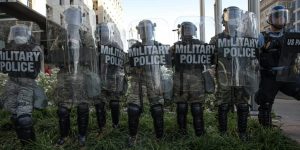
In any normal era, the idea of a president deploying the U.S. military against his own citizens would sound like dystopian fiction. Yet here we are, again, entertaining the very real possibility that Donald Trump might try to invoke the Insurrection Act, a centuries-old law written for genuine rebellion, not for televised political theater.
Trump has teased it the way a magician teases his final trick, suggesting that if protests, border clashes, or “unlawful combinations” erupt, he may have “no choice” but to use the military “to restore order.” What he leaves unsaid is that he would define the disorder.
And that my friends is what makes the threat so dangerous.
The Law That Was Never Meant for Politics
The Insurrection Act of 1807 was created to quell true insurrections which are rare, extraordinary moments when rebellion genuinely threatened the Republic.
It’s been invoked only a handful of times in the modern era.
Eisenhower sent troops to Little Rock to enforce desegregation.
Lyndon Johnson to Detroit to stop riots.
It was never intended to be a political pressure valve or a campaign prop.
But the law’s language is alarmingly vague. It empowers the president to use force to suppress any “unlawful obstruction” or “domestic violence” that makes enforcing the law “impracticable.” In plain English, if a president claims that chaos reigns, the statute offers little resistance.
That’s the crack in the foundation and Trump, ever the opportunist, knows exactly where to press.
A Crisis of His Own Making
Trump doesn’t just respond to any crisis he manufactures it. He creates the problem, amplifies the panic, then offers himself as the solution.
It’s the oldest trick in the autocrat’s playbook, chaos as currency, fear as leverage, and order as a product you can only buy from him.
Already, he’s floated the idea publicly. He’s framed protests as “rebellions,” accused governors of “defying federal law,” and called cities “lawless.” Friendly pundits echo the rhetoric, preparing the public to accept military force as “necessary.”
But invoking the Insurrection Act wouldn’t restore calm rather, it would showcase control. It’s the ultimate visual for Trump, soldiers saluting, crowds dispersing, headlines proclaiming “decisive leadership.”
Except that it would also trigger a constitutional earthquake.
Governors would most likely defy federal command.
Courts will intervene.
Even the Pentagon, wary of politicization, might refuse to comply.
The result wouldn’t be stability it would be a national fracture.
A Dangerous Precedent Wrapped in Patriotism
Once the military is deployed on domestic soil for political convenience, it’s not easily rolled back. It redefines the boundaries between citizen and state. What begins as an “emergency measure” often becomes precedent and precedent is the quiet killer of republics.
Trump’s supporters would see strength. His critics would see tyranny. The rest of America would see soldiers on Main Street and wonder how democracy turned into occupation.
If he succeeds once, it won’t be the last time a president uses the military for politics. The line between law enforcement and martial law will blur, and future leaders will remember how easy it was to justify.
The Real Insurrection
The true threat isn’t a mob in the streets. It’s a man in power, clutching a statute like a loaded weapon and calling it patriotism.
Yes, the odds of Trump invoking the Insurrection Act remain low, maybe 20 or 30 percent but, the real danger lies in the possibility itself. Democracies rarely collapse all at once; they erode in increments, one “emergency” at a time.
When a president turns soldiers toward his own people, he’s not defending America he is in fact redefining it.
And if Trump decides to cross that line, the country may never fully cross back.
It’s not rebellion Trump fears, it’s resistance.
And he’s willing to call both by the same name.
 PRAGMATIC ISSUES
You must be logged in to post a comment.