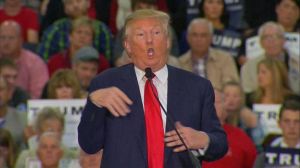
President Donald Trump was at Mar-a-Lago on Thursday night when Nancy Cordes, chief White House correspondent for CBS News, asked him an unremarkable question about the suspect in the shooting of two National Guard members in Washington, D.C. Cordes cited a Justice Department inspector general’s finding that Afghans who entered the United States after the fall of Kabul were thoroughly vetted.
This was the moment for facts.
Or policy.
Or even a coherent disagreement.
Instead, the President of the United States snapped.
“Are you stupid? Are you a stupid person?”
That wasn’t strength. It wasn’t strategy. It wasn’t some alpha-posturing triumph that fans would later try to launder into genius. It was incompetence, live on camera, a man who could not process information fast enough to respond and defaulted, once again, to insult.
This is what failure sounds like when it panics.
There is a tidy myth Trump’s defenders like to sell. They insist every outburst is intentional, every tantrum a masterstroke, every insult a carefully calibrated distraction. It’s a comforting fairy tale, because it avoids the far simpler and far more dangerous truth.
Sometimes a leader melts down because he doesn’t understand what he’s being asked.
Trump didn’t rebut the inspector general’s findings. He didn’t challenge Cordes’ sourcing. He didn’t even attempt to redirect. He went straight to humiliation because humiliation is cheaper than comprehension and safer than admitting ignorance.
That is not domination of the press.
That is intellectual retreat.
And no, this was not an isolated incident. Trump has a long, documented pattern of targeting women journalists in particular questioning their intelligence, mocking their voices, belittling their presence. It’s not coincidence.
It’s instinct.
Women who ask informed questions puncture the illusion he relies on, that confidence equals competence.
If I were in the press room, I would confront him directly. Because silence in the face of abuse isn’t professionalism. It’s obedience. And journalism that tiptoes around presidential tantrums isn’t watchdog reporting, it’s theater with credentials.
Yes, there is a broader media strategy at work. Trump’s ecosystem has long relied on overwhelming the public with constant noise scandal stacked on outrage stacked on nonsense until nothing can be held in focus long enough to demand accountability. His former adviser Steve Bannon gave the game away years ago when he described it plainly “flood the zone with shite.”
But here is the part Trump loyalists don’t want to confront:
Incompetence is the fuel that makes the strategy necessary.
The flood exists because governance doesn’t. The shouting exists because answers don’t. The insults exist because inspection is fatal. Chaos becomes camouflage for a president who cannot, or will not, do the work.
Trump’s defenders like to frame moments like this as evidence of fearlessness proof he’s willing to “take on” the press. In reality, it’s the opposite. It’s a man terrified of follow-up questions, of expertise, of women who won’t perform deference, and of facts that resist intimidation.
Democracies don’t usually die in a blaze of spectacle. They rot in a constant din leaders yelling, supporters cheering, journalists scrambling, until citizens grow exhausted and stop expecting answers at all.
That is the real danger here. Not that Trump insults reporters, but that the pattern numbs the public. That incompetence becomes normalized. That abuse becomes background noise. That the presidency is reduced to grievance theater for an audience trained to mistake volume for authority.
Trump didn’t outsmart Nancy Cordes.
He exposed himself.
And no amount of shouting can change that diagnosis.
Then again this administration would do anything to draw attention away from the REDACTED Epstien files and Karoline Leavitt’s relative being deported or from anything that affects the Average American, Voter.
 PRAGMATIC ISSUES
You must be logged in to post a comment.