How Trump Just Taught the World That the Rules Are Dead
When a US president openly threatens a foreign leader with a “fate worse than Maduro’s,” he is not posturing. He is signalling the end of restraint—and inviting every strongman on Earth to follow suit.
The Atlantic put it plainly and without euphemism: “Trump threatens Venezuela’s new leader with a fate worse than Maduro’s.”
That single sentence should chill anyone who still believes the United States is committed to international law, sovereignty, or the rules-based global order it claims to defend.
This is not bluster.
This is doctrine.
When a sitting US president speaks openly about abducting or destroying foreign leaders outside any recognised legal framework, he is not engaging in diplomacy. He is issuing threats that sound indistinguishable from those made by the very autocrats Washington claims to oppose. The language matters. The precedent matters more.
Trump’s actions and rhetoric around Venezuela are not complicated. They are not clever.
They are not strategic.
They are the crude assertion that power replaces law when it becomes inconvenient.
And once the United States embraces that logic, the entire international system begins to rot from the inside out.
Kidnapping a head of state whether you call it an arrest, removal, or “security operation” is not justice.
It is the rejection of sovereignty itself.
Threatening a newly installed leader with a fate “worse” than his predecessor is not deterrence. It is intimidation. And intimidation, when wielded by the world’s most powerful military, does not stay contained.
For decades, the US insisted that borders mattered. That leadership changes required international consensus. That even enemies were entitled to due process under international law. Those principles were imperfectly applied, often hypocritically so but they existed.
Trump has now stripped away even the pretense.
The message to the world is unmistakable. If Washington can seize or threaten foreign leaders it dislikes, then Moscow can do the same. Beijing can do the same. Any regional power with ambition and weapons can do the same. Complaints from the US will ring hollow, because the precedent will already be set in English, broadcast globally, from the Oval Office.
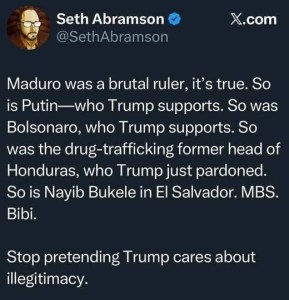
Trump’s defenders insist this is about fighting corruption or restoring democracy whilst they ignore the corruption Trump and his administration have brought down on the very country they serve.
Democracy cannot be imposed by kidnapping. Accountability cannot be delivered by threats. And human rights cannot be defended by abandoning the legal architecture designed to protect them. What this is, in reality, is the normalisation of imperial behaviour in a post-imperial world.
The danger here is not Venezuela alone. It is the domino effect. Once leaders become fair game, negotiations collapse. Treaties lose meaning. Diplomacy becomes theatre, backed by force rather than law. The world does not become safer under those conditions—it becomes volatile, paranoid, and primed for escalation.
Trump is not projecting strength.
He is advertising recklessness.
He is telling allies they are expendable, adversaries that restraint is optional, and aspiring authoritarians that the old rules no longer apply.
The moment the United States decided it could kidnap one leader and threaten another with a fate “worse than Maduro’s,” it forfeited the moral authority to object when Putin, Xi, or any future strongman does the same. When the next abduction happens and it will, Washington will issue statements, demand accountability, and invoke international law.
The world will respond with silence.
Because it will remember exactly who taught them that power, not principle, is now the only law left standing.
 PRAGMATIC ISSUES
You must be logged in to post a comment.