Something unusual is happening and it’s worth paying attention to, regardless of where you stand politically.
It reminds me of an old Movie, Team America: World Police, Trey Parker and Matt Stone did this little gem back in the early 2000’s.
As tensions rise with Iran, some of America’s closest allies are choosing not to follow Washington’s lead.
They’re hesitating.
Asking questions.
In some cases, declining outright.
That’s not how this usually works.
For decades, the United States has relied on a network of alliances that, while sometimes strained, were ultimately dependable.
When America moved, others often moved with it not blindly, but with a shared understanding that U.S. leadership, for all its flaws, was anchored in coordination and long-term strategy.
So when that pattern breaks, it’s not just a diplomatic moment.
It’s a signal.
The easy explanation is to frame this as weakness on the part of our allies. That they’re unwilling to step up. That they’re leaving the United States to handle difficult problems alone.
But that explanation doesn’t hold up under scrutiny.
These are the same countries that stood with the United States in past conflicts, contributed troops, shared intelligence, and absorbed political risk alongside us. They haven’t suddenly become incapable.
What’s changed is their level of confidence.
To begin with the fact that Trump administration has admitted that they have zero proof that Iran posed an imminent threat to the United States, much less that a nuclear arsenal at it’s disposal.
Like with Venezuela, no proof just an invasion, one that benefited the United States and no-one else.
Confidence in the strategy.
Confidence in the objective.
And, increasingly, confidence in the leadership asking them to commit.
That’s the uncomfortable part.
Under President Trump, American foreign policy has taken a more unpredictable turn, marked by abrupt decisions, lies, shifting positions, and a more transactional approach to long-standing relationships. Supporters see this as strength and independence.
Critics see it as instability.
Our allies, however, don’t have the luxury of viewing it as either.
They have to make decisions based on risk.
And from their perspective, the risks right now are significant.
A conflict with Iran doesn’t stay contained.
It spreads, economically, militarily, and politically.
It affects energy markets, regional stability, and the safety of their own populations.
So they’re asking the question any responsible government would ask:
Is this strategy clear?
And is it worth the cost?
If the answer isn’t obvious, hesitation is not betrayal.
It’s prudence.
That doesn’t mean the United States is wrong to take threats seriously. Iran is a complex and often dangerous actor, and there are legitimate concerns that deserve attention but not the ones Trump and his administration have already admitted they lied about.
And, leadership is not just about identifying threats.
It’s about convincing others that your response is the right one.
And that’s where the current approach appears to be falling short.
Because when allies begin to step back not out of opposition, but out of uncertainty, it reflects something deeper than disagreement.
It reflects doubt.
Doubt that the plan is fully formed.
Doubt that escalation has been carefully weighed.
Doubt that, if things go wrong, the consequences have been fully considered.
That kind of doubt doesn’t emerge overnight.
It builds over time.
Through strained relationships, inconsistent messaging, and decisions that appear reactive rather than strategic.
To be clear, this isn’t about one moment or one headline.
It’s about a pattern.
And patterns shape perception.
Right now, the perception taking hold is not that the United States lacks power.
It’s that it may lack predictability.
And in international politics, predictability is what allows allies to take risks alongside you.
Without it, even the strongest partnerships begin to pause.
So this moment isn’t just about Iran.
It’s about whether the United States can still bring others with it when it matters most.
Because a country can act alone.
But leadership is measured by whether it has to.
And if allies increasingly choose distance over alignment, the question isn’t just what they’re doing.
It’s why.
When long-standing partners hesitate, it’s rarely impulsive.
It’s usually a response.
A response to what they’ve seen.
What they’ve experienced.
And what they no longer feel certain about.
That’s not a comfortable conclusion.
But it’s an important one.
Because the real risk isn’t that America’s allies are failing.
It’s that they’re making a calculated decision that following, this time, may carry more danger than standing back.
And if that becomes the new normal, it won’t be because the world suddenly changed.
It will be because confidence in American leadership did.
The reality is, this isn’t just about Iran.
It’s about a United States confronting something it hasn’t had to face in generations:
Allies are no longer willing to follow on instinct.
That shift didn’t happen overnight and it didn’t happen by accident.
It is the result of years of treating alliances as leverage, more so now that Trump is in office, instead of building relationships, of replacing consistency with impulse, and of mistaking unpredictability for strength.
And, because American’s no longer believe in Trump or his administration. That my friends puts America in a bit of an interested predicament.
And now, when the stakes are highest, that approach is being tested in real time.
The response isn’t outrage.
It’s distance.
Because the world isn’t rejecting America.
It’s rejecting how it is currently being led.
That distinction should matter, especially to those who still believe American leadership is worth restoring.
Which right now, you’d be hard pressed to find a unified, united America that believes American leadership is worth restoring.
Trump is trying to align himself with an ideal or persona if you will that he will never, ever become. He is not great, he is not a King, he is not a God. He isn’t even a ruler.
He is lacklustre, uneducated in terms of aligning himself properly with the world today and America, he is in fact, aging out.
I doubt he nor his administration have thought about the consequences of the economy he has ruined in less than a year, the costs of his Trade War that isn’t panning out, the cost of his refusal to help our farming industry, DOGE, the fact that the people that ran it cost the country millions if not more and had no fucking clue what they were doing.
His administration spending tax dollars on expensive planes, meals, drinks, socialising.
He has managed to ruin peoples lives by costing them their life savings just to be able to put a meal on the table, afford fuel, housing, the Job Market is shedding jobs faster than I can down a cup of fresh out of the pot coffee, the American people are stretched so far financially that the bow will break at some point.
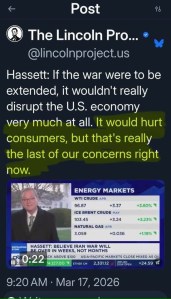
Add a war no one asked for, which costs the American people even more and you get unrest.
We’ve seen it in other countries, you get civil unrest. What is the administration do then? You are sending our military to fight a war, the police across the entire country are stretched thin, some police forces in smaller rural cities and counties are shuttering completely.
What is the plan then?
Because sooner or later people are going to want to take back our government from the dictator his is holding it hostage.
 PRAGMATIC ISSUES
You must be logged in to post a comment.