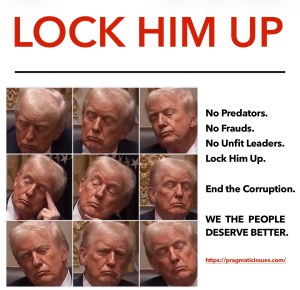
There was a time when the idea of a geopolitical rival calling for regime change in the United States would have been laughable.
Now it’s just American sentiment towards an administration that is rife with corruption being run by one of the most vile corrupt men in then world.
This week, Iranian state messaging pushed past routine hostility and into something far more pointed casting itself not merely as an adversary, but as a corrective force.
Not only have they called out the President’s lies, they have laughed at him, they have pushed video on social media depicting themselves a the only ones who can save the world and America from Trump and his administration.
In its telling, Iran is not the destabilizer, but the stabilizer. Not the threat, but the solution. A nation positioning itself as capable of saving the world from what it describes as a corrupt American presidency.
It is propaganda.
Or maybe it’s not.
Propaganda works when it sounds just believable enough to repeat.
Right now, America is making that easier than it should be.
At home, the administration is no longer defined by control, but by contradiction. Allegations, internal fractures, and public missteps are not isolated, they are stacking. Senior officials are shadowed by controversy.
Credibility is thinning.
House Republicans are no longer quietly divided, they are openly splintering.
Even core initiatives tied to national security and governance appear to strain under their own weight.
This is not just dysfunction.
It is spectacle.
And spectacle erodes authority faster than opposition ever could.
Power, at its core, is only perception after all.
It depends on the quiet assumption that someone, somewhere, is firmly in control.
When that assumption weaken, when leadership appears reactive, when messaging feels improvised, when allies hesitate, that perception begins to fracture.
Once it fractures, it spreads.
That is why developments like the proposed Skydance merger are drawing such scrutiny. Not simply as a business deal, but as a signal. A signal that the line between political power and media influence is being tested in ways that Americans have historically criticized elsewhere. Systems where narrative and authority move together, where dissent narrows, where control becomes less visible and more structural.
The comparison is uncomfortable.
It should be.
Layer onto that the growing noise around cybersecurity breaches, like Kash Patel’s email being hacked by Iran, internal leaks, and exposed communications, whether fully verified or not and the effect compounds.
Because in modern politics, perception does not require perfection.
It only requires plausibility.
And plausibility is exactly what adversaries exploit.
None of this means Iran is right.
It doesn’t have to be.
Iran has simply started to capitalise on American sentiment.
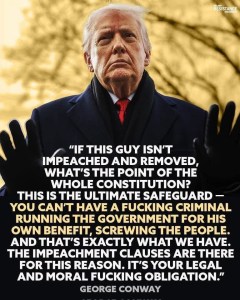
Because the real shift is not in what Iran is saying, it is in how easily the message travels.
For decades, the United States has positioned itself as a stabilizing force. Imperfect, often contradictory, but ultimately grounded. That grounding is now being questioned- by America. And when a superpower begins to look uncertain, it doesn’t just invite criticism.
It invites opportunity.
Superpowers don’t fall when their enemies attack.
They fall when their enemies stop taking them seriously.
That is the shift happening now.
Not a war, not a collapse but something quieter and far more dangerous, a loss of credibility so visible that even adversaries feel confident enough to mock it.
And the most damning part is this
If Iran can convincingly position itself, even for a moment, as the more stable voice in the room, then the problem is no longer propaganda.
The problem is that America is making it believable.
 PRAGMATIC ISSUES
You must be logged in to post a comment.